“Serve the People!” sign in the Division Commander’s house
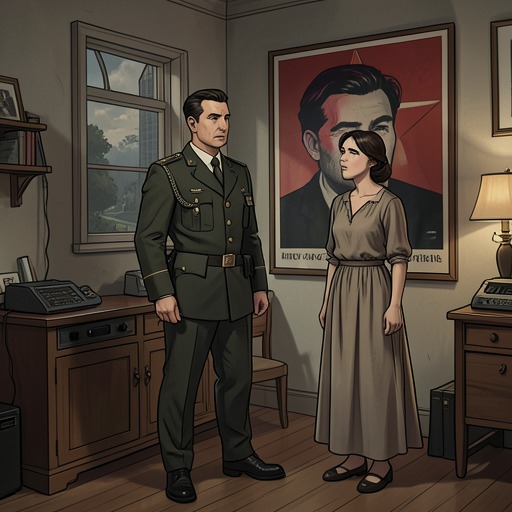
Serve the People!The “Serve the People!” sign in the Division Commander’s house is at once a revolutionary emblem and a silent summons: Liu Lian uses its displacement to call Wu Dawang upstairs, converting a public slogan into the private language of their affair. Its meaning shifts with its location, while the household’s ordinary routines preserve the appearance of military propriety. The board therefore gives material form to the story’s central irony: Wu Dawang’s prescribed service to the Division Commander’s family becomes entangled with a secret relationship that official language cannot name.
Appearance and Official Meaning
The sign is a wooden board painted with the words “Serve the People!” in bright red letters. Five stars appear to the left of the exhortation; to the right, a rifle carries a water canteen, with a row of wheat beneath. Its red and yellow imagery on a whitewashed ground presents a compact revolutionary allegory: the stars signify the Revolution, the rifle and canteen recall the Party’s history of armed struggle, and the wheat promises future abundance after the achievement of Communism.
The Division Commander brings the board home and asks Wu Dawang what it means as the orderly sets down food. The question establishes the object as part of the household’s political instruction as well as its decor. Wu Dawang is described as an exemplar of political correctness with an unusually developed understanding of its symbols. The board thus belongs to a world in which domestic work, military hierarchy, and revolutionary ideals are presented as parts of one duty: to serve senior officers is, in Wu Dawang’s accepted understanding, to serve the people.
From Emblem to Signal
The sign’s position becomes a message. Three days before the narrative returns to the kitchen, Liu Lian removes it from its usual place against the wall and lays it on the dining table after dinner. Calling Wu Dawang “Xiao Wu,” she tells him that whenever the sign is not in its usual place, she needs him upstairs. She taps the board against the table before going upstairs, giving its movement a deliberate, wordless emphasis.
At first, Wu Dawang is unsure what the altered placement means. He returns the board to its proper place and carries on with washing dishes and other household work. Later, after tending the garden and pruning scarlet roses, he sees it in the living room at the foot of the stairs. He reads this second displacement as a call to go upstairs, even as the Division Commander’s earlier warning not to concern himself with the upper floor comes back to him. The board’s new location does not erase that rule; it creates a conflict between the official boundary and Liu Lian’s private instruction.
Liu Lian subsequently restates the convention when dismissing him: whenever the sign is not on the table, she wants him upstairs. Back in the narrative present, it has left the dining table again and lies on the kitchen worktop. Wu Dawang returns from the vegetable garden holding pak choi intended for Liu Lian’s next morning’s meal. The sight of the sign stops him; the greens slip from his hands, and he understands that the summons is about to lead him into an affair that threatens his reputation and prospects. What began as an ambiguous rearrangement has become a recognizable code, and the sign’s return makes anticipation part of its function.
A Repeated Code and a Public Facade
Once the relationship is underway, the board’s movement becomes a recurring action rather than a single invitation. Liu Lian can place it where Wu Dawang will find it as he works in the garden, and he responds by taking it inside and going upstairs. At times she sets it down nearby and leaves on the pretext of fetching water; at another moment she slips it beneath his knife while he chops vegetables. Their private arrangement requires no further explanation: the object carries the message, and its discovery interrupts the orderly sequence of work.
The signal extends through the domestic spaces in which Wu Dawang serves. It can appear in a shrub or hang from a vine as he tends the grounds; after he discovers it at the compound, their meetings occur in rooms that include the sitting room, kitchen, bathroom, study, and the Division Commander’s conference room, as well as beneath the vine trellis after dark. The sign does not merely point toward a particular upstairs room. Its recurring presence makes the whole household’s revolutionary setting available for a secret use that reverses the object’s official purpose.
Outside, Wu Dawang continues to garden and perform his orderly’s duties, helping preserve the appearance that nothing has changed: Liu Lian remains the Division Commander’s wife, and he remains the household orderly. The contrast between this visible routine and the private meaning of the sign is essential to its narrative role. The public board still declares service, but for the two characters its relocation marks a concealed departure from the roles they display to others.
Intimacy, Reversal, and Aftermath
A later scene concentrates the sign’s double meaning in a single image. After Liu Lian says “Serve the People” and tells Wu Dawang to take off his jacket, its slogan is visible on the undershirt beneath. The political phrase is therefore repeated not only on the wooden board but on the clothing associated with Wu Dawang’s orderly role. Official language becomes part of the lovers’ private performance, even as the scene exposes the gap between the uniform idea of service and the personal desires that have taken hold.
The board also witnesses the relationship’s less controlled moments. After Wu Dawang and Liu Lian drink together, they awaken on the kitchen floor with the sign lying across them like a price tag. Its presence turns an emblem of collective purpose into an unsettling marker of a private entanglement, while the scene’s disarray contrasts with the disciplined image the household ordinarily projects.
When the couple later destroy objects associated with Mao Zedong and the Revolution, the sign becomes an exception. Liu Lian lifts it to smash it, but Wu Dawang takes it from her and carefully returns it to the table, saying that he wants to keep it. This is a decisive reversal: the board has served as her summons, yet he now claims it as something to preserve. His action distinguishes it from the other revolutionary objects they deface and reveals that, despite his rebellion against the household’s political symbols, this particular object has acquired an intimate value of its own.
Near the end of their three-day confinement, Liu Lian picks up the sign from the table before Wu Dawang carries her upstairs. The object remains present at a moment when their private world is nearing its end, but it no longer functions only as a coded instruction. Its successive uses—as official emblem, covert summons, witness to their affair, and object Wu Dawang chooses to save—give the board a changing narrative life. Through it, the story makes the familiar slogan unstable: the words remain fixed, while the human actions gathered around them alter what service means.